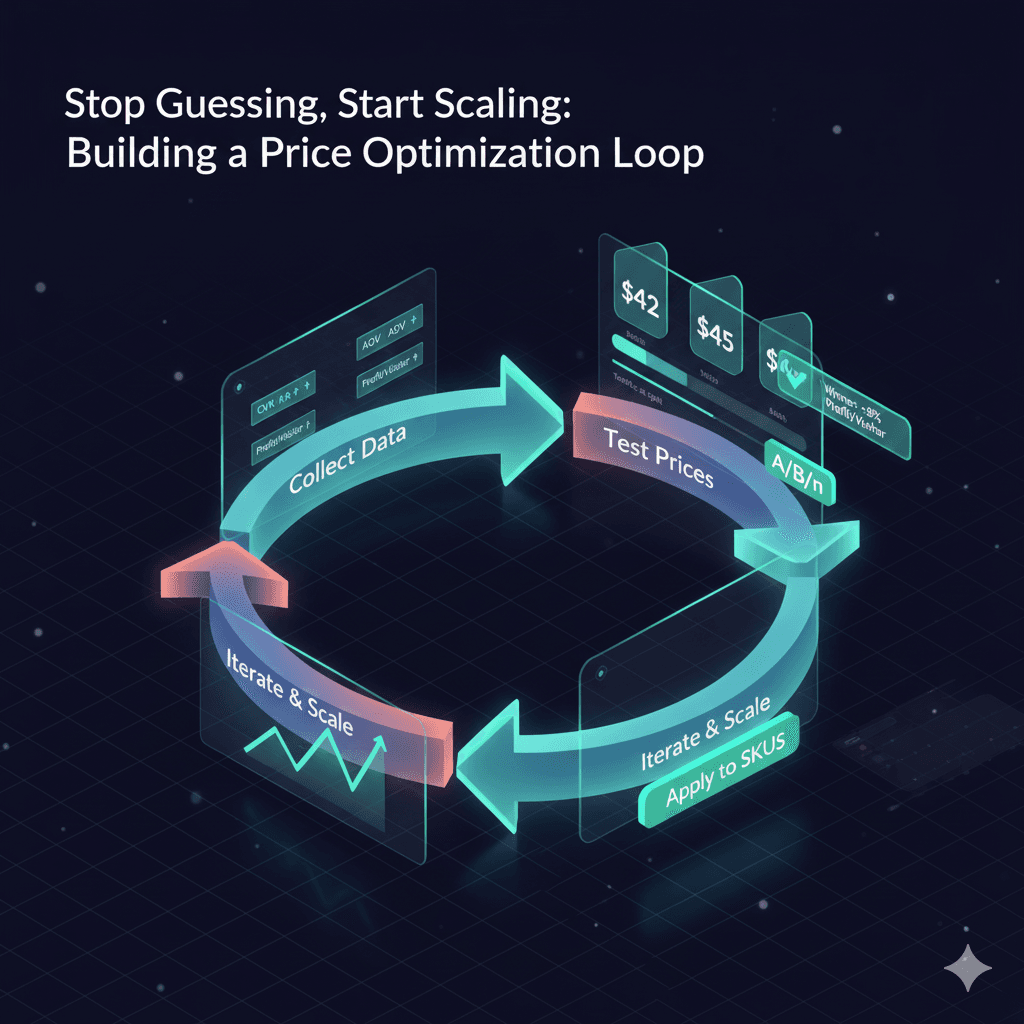
Step 1
Collect Data
Track price performance — CVR, RPV, and margin per visitor — to find starting points.
Step 2
Test Prices
Run A/B/n tests with 5–10 variations. Let traffic decide which price wins.
Step 3
Iterate & Scale
Lock in the winning price, roll it out across products, and repeat every quarter.
Don’t guess — build a price optimization loop. Measure performance, test variations, and automate learnings with tools like Pricision. The goal isn’t one perfect price; it’s a system that keeps finding new winners.
🧭 What Is a Price Optimization Loop?
A price optimization loop is a repeatable process that continuously improves pricing decisions based on live performance data. Instead of guessing or reacting to competitors, your brand learns from real buyer behavior and applies those insights over time.
It’s the difference between running one test and running a self-learning system that compounds revenue every cycle.
⚙️ The 4 Components of an Optimization Loop
1. Data Collection
Pull performance data directly from Shopify or analytics tools. Focus on key metrics: conversion rate, average order value, and profit/visitor.
- Hypothesis Creation
Use insights to form test ideas: “Will .99 endings lift CVR?” or “Can $49 outperform $45?” Always test assumptions.
3. A/B/n Testing
Run simultaneous tests using tools like Pricision to distribute traffic evenly and calculate statistical winners.
- Learning & Iteration
Feed test results back into your pricing logic. Each round strengthens your model and your profitability.
📈 Why Loops Outperform One-Off Tests
Continuous Learning
Each test improves the next one. Your pricing adapts to changes in seasonality, demand, and ad costs.
Compounding Profit
Tiny lifts in price efficiency (even 2–3%) stack over time for exponential revenue gains.
🧠 Example: $49 vs $45 vs $42 — Real Shopify Results
A home goods brand tested 3 price points across a hero SKU. $49 outperformed $45 by 8% in profit per visitor — despite slightly lower conversion — proving that optimization loops uncover hidden leverage.
Instead of lowering prices, they now run micro-tests every quarter and adjust dynamically.
Create a living system that learns faster than your competitors. Test, learn, repeat — and scale your pricing clarity with automation.
Start Free Trial →